How debt consolidation works
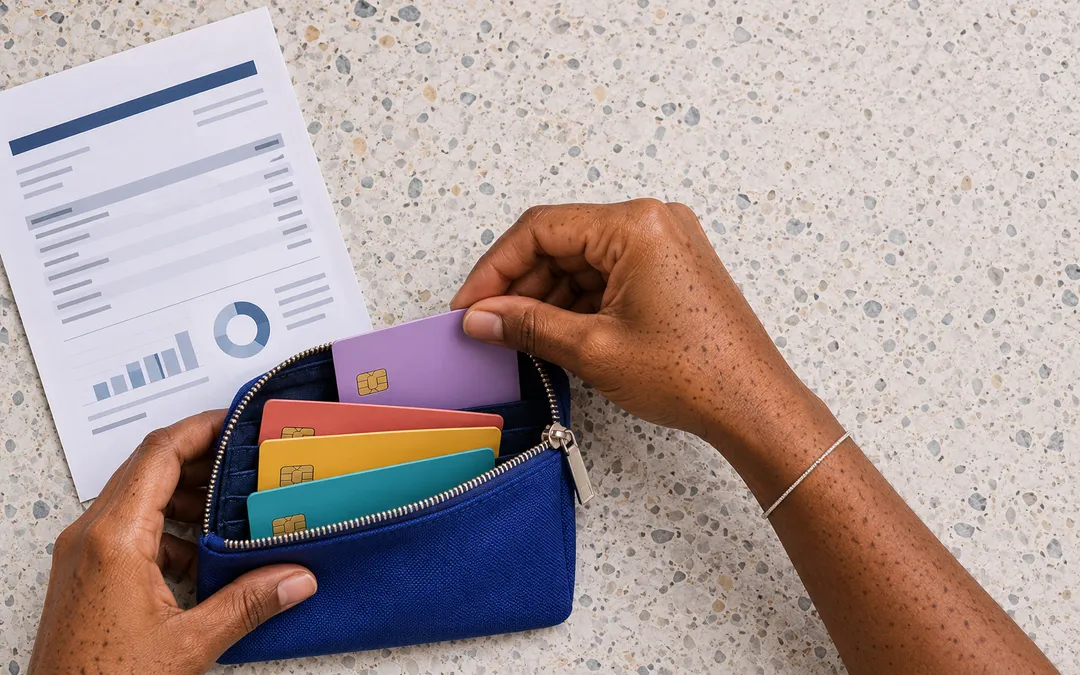
You take one fixed-rate personal loan and use it to pay off several higher-rate balances — usually credit cards. Instead of three or four minimum payments at 22%–29% APR that barely touch principal, you have one payment, one rate and a payoff date.
Many lenders in our network will pay your card issuers directly, so the balances are cleared the day the loan funds. The cards stay open; keeping them open but unused is what lowers your utilization and helps your score.
The math on a typical consolidation
A borrower carrying $4,800 across two cards at 27% APR and paying $160 a month would need about 4 years and roughly $2,900 in interest to clear them. The same $4,800 as a 36-month loan at 14.00% APR costs $164.05 a month and $1,105.89 in interest — done in three years.
| Two cards at 27% | Consolidation loan at 14% | |
|---|---|---|
| Monthly payment | $160 (minimums) | $164.05 |
| Time to payoff | ≈ 48 months | 36 months |
| Total interest | ≈ $2,900 | $1,105.89 |
| Rate type | Variable | Fixed |
Illustrative. Card payoff assumes payments held at $160; actual minimums fall as balances drop, which stretches payoff further.
TransUnion's Q2 2026 data shows borrowers who consolidate with a personal loan cut their card utilization by an average of 18 points — one of the fastest ways to lift a score.
When consolidation is worth it — and when it isn't
Worth it when
- Your loan APR is clearly below your cards' APR
- You can afford the fixed payment with headroom
- You'll stop adding new card balances
- Total interest, including any origination fee, is lower
Not worth it when
- The loan APR is similar to or higher than your cards'
- You could clear the cards within 6 months anyway
- You qualify for a 0% balance-transfer card and can pay it off in the promo window
- The real problem is monthly spending, not past balances
How to consolidate in four steps
- List every balance, APR and minimumUse your statements. Total the balances and note the highest APR.
- Check your rateTwo-minute request, soft pull. Ask for the total of the balances you want to clear.
- Compare total cost, not just the paymentAPR × term. A longer term lowers the payment but can raise total interest above what you pay now.
- Pay the cards off — and leave them openDirect-pay lenders do this for you. Closing cards raises utilization and can lower your score.
Who qualifies
- Credit scores from the mid-500sThe best consolidation rates go to scores above 660.
- Debt-to-income under ~45% after consolidationLenders count the new loan and subtract the cards it pays off.
- Verifiable incomeEmployment, self-employment, benefits or retirement.
- Balances within $200–$5,000Larger balances may need a bigger lender; see our resources.
Frequently asked questions
Does debt consolidation hurt your credit?
Briefly, a few points from the hard inquiry when you accept a loan. Then it usually helps: utilization drops when the cards are paid off, and on-time instalment payments build history.
Should I close my credit cards after consolidating?
No. Keep them open with a zero balance. Closing them raises your utilization ratio and shortens your credit history.
Can I consolidate payday loans?
Yes. Replacing a 400% APR payday loan with a 36% APR personal loan is one of the most valuable uses of consolidation.
What if my debt is more than $5,000?
Lenders in our network cap at $5,000. You can consolidate the highest-rate portion, or see our guide to larger loans in the resources section.
Is there a fee?
Some lenders charge an origination fee of 0%–8%, included in your APR. Compare APRs, not interest rates, to see the true cost.